

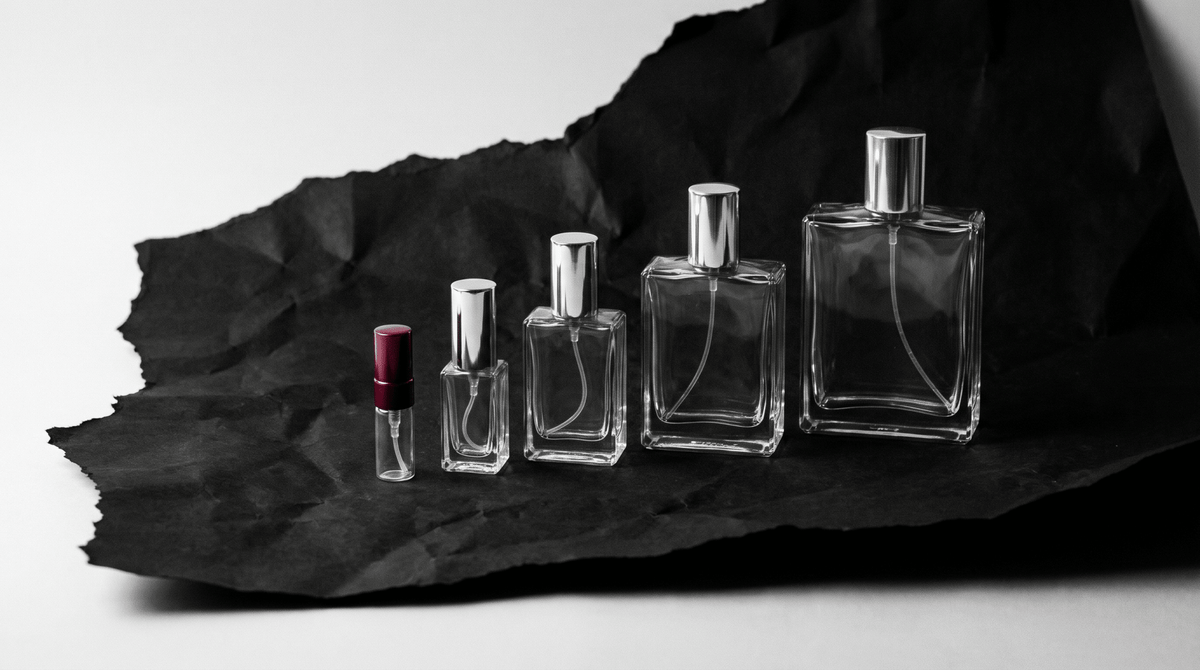
You're probably standing in front of three boxes right now. 30 ml, 50 ml, or 100 ml. Same scent, different price, and the larger bottle looks like the “smart” buy. That's where the wrong decision is often made.
Choosing among cologne bottle sizes isn't just about paying less per milliliter. It's about how you wear fragrance. Are you testing a scent? Building a rotation? Buying a signature? Traveling often? Collecting more than you finish? Those are different jobs, and they call for different sizes.
That distinction matters more than most shoppers realize. Cologne as a category goes back to 1709, when Johann Maria Farina created Eau de Cologne in Cologne, Germany, a foundation that shaped the lighter, more everyday style many people still associate with cologne today, as noted in the history of Eau de Cologne. The modern retail wall may feel standardized, but your use case isn't.
Table of Contents
- The Strategic Choice Behind Every Cologne Bottle
- Decoding the Numbers Standard Cologne Sizes in ML and OZ
- Beyond the Full Bottle A Guide to Fragrance Formats
- How to Choose the Right Cologne Size for Your Needs
- The Hidden Factors Storage Freshness and Travel Rules
- Getting the Most from Your Samples and Decants
- Your Final Checklist for Choosing the Right Size
- Frequently Asked Questions About Cologne Sizes
The Strategic Choice Behind Every Cologne Bottle
Most shoppers treat size like a math problem. Bigger bottle, lower cost per milliliter, done. That's too crude for fragrance.
A bottle size is really a portfolio decision. One size serves discovery. Another serves daily wear. Another serves collectors who rotate through a shelf of scents and would rather preserve quality than chase “value.” If you buy every fragrance as if it's your forever signature, you'll overspend and overstore.
Think in roles, not just volume
A good fragrance wardrobe usually has three roles:
- Testing scents: You want enough wear to judge the opening, dry-down, and how it behaves on your skin.
- Rotation bottles: These are scents you reach for often, but not every day.
- Signature bottles: These earn the larger format because you know you'll use them.
That's the right lens for cologne bottle sizes. Not “Which one is cheapest per ml?” but “What job is this bottle supposed to do?”
Practical rule: Buy large only when your wearing habits justify it. A big bottle of a scent you rarely reach for is not a deal. It's expensive storage.
Why the modern size wall feels so rigid
Retail has trained shoppers to compare neat tiers. That can make the choice feel more universal than it really is. It isn't. Fragrance history was far less standardized, and bottle size evolved around status, portability, and practicality long before the modern department-store shelf.
So if you feel torn between sizes, you're not indecisive. You're sensing a real tradeoff between flexibility, value, and commitment. Good instinct. Keep it.
Decoding the Numbers Standard Cologne Sizes in ML and OZ
Most commercial cologne bottle sizes cluster around a small set of familiar formats. The recurring standards are 30 ml (1 fl oz), 50 ml (1.7 fl oz), 75 ml (2.5 oz), and 100 ml (3.4 oz), with 50 ml and 100 ml especially common because they balance portability, value, and buyer familiarity, according to this perfume bottle sizes guide.
That standardization helps retailers plan shelves and helps you compare one fragrance against another without recalculating every purchase from scratch.

Cologne bottle size conversion chart
| Metric (ml) | Imperial (fl oz) | Typical Use Case |
|---|---|---|
| 30 ml | 1 fl oz | Trial full bottle, lighter rotation, gifting |
| 50 ml | 1.7 fl oz | Best all-around size for regular use |
| 75 ml | 2.5 oz | Strong option for committed wearers |
| 100 ml | 3.4 oz | Full-size benchmark for signature scents |
What each size really means
30 ml is the cautious buyer's full bottle. It's ideal when you know you like a fragrance but don't yet know if you love living with it. It also makes sense for someone with a broad rotation who wants variety without creating a graveyard of half-used bottles.
50 ml is the most balanced choice on the shelf. It gives you enough volume to wear the scent properly over time, but it doesn't lock you into a long-term commitment the way a bigger bottle can. If you want one answer, this is it.
75 ml sits in a slightly awkward but useful middle ground. It suits someone who already knows the fragrance works and wants a bit more headroom without jumping to the largest standard bottle.
100 ml is the benchmark most brands treat as the true full size. That makes it easy to compare prices and positions it as the obvious “best value” option. Sometimes it is. Sometimes it isn't. The bottle only makes sense when the scent is in heavy rotation.
A 100 ml bottle often wins on headline value. That doesn't automatically make it the right purchase for your habits.
The quick read at the counter
If you're deciding fast, use this shorthand:
- 30 ml: Interested, but not fully committed
- 50 ml: Confident and practical
- 75 ml: Very likely to use often
- 100 ml: Signature scent territory
That framework will save you from buying too much bottle for too little wear.
Beyond the Full Bottle A Guide to Fragrance Formats
Bottle size is only part of the story. Format matters just as much.
The classic retail flacon gets most of the attention, but smaller fragrance formats often make better strategic sense. Samples, decants, travel sprays, and minis all solve different problems. If you buy only full bottles, you'll spend more and learn less.
Historically, compact fragrance containers aren't some modern workaround. They're part of perfumery's long tradition. Evidence from antique scent-bottle collections spanning the 18th century to the early 20th century shows examples under 9 cm, highlighting how portable fragrance formats long predated today's travel sprays and testers, as shown in this history of scent-bottle design.

Full bottles, minis, travel sprays, and decants
Here's the practical difference.
- Full retail bottle: Best when the fragrance has already proved itself in your life. You know the scent, the dry-down, and how often you wear it.
- Official mini: Great for gifting and collecting. Charming, but not always the most practical if you prefer atomizers.
- Travel spray: Ideal for commuting, office bags, and short trips. It's the easiest everyday carry format.
- Decant: The most efficient tool for serious testing. You get enough fragrance to wear it repeatedly without paying for a full bottle.
A decant is especially useful when you're exploring niche houses, discontinued scents, city exclusives, or fragrances that deserve more than one quick wrist test. If you want a deeper explanation of how the format works, this beginner's guide to perfume decants lays it out clearly.
Why smaller formats often beat the “real bottle”
A full bottle looks glamorous on a shelf. That doesn't mean it's the smartest first move.
Decants and travel formats let you test in real conditions. Cold day, warm day, office setting, evening wear, post-shower skin, dry skin. That's how you learn a fragrance. Not by spraying cardboard under department-store lighting.
If you're shopping for someone else, smaller ready-to-send fragrance options can also make more sense than guessing a full bottle. A curated source for nationwide perfume gift delivery can be useful when you want scent to arrive as a polished gift rather than as a rushed errand.
Small formats aren't a compromise. They're precision tools for discovery, mobility, and smarter buying.
How to Choose the Right Cologne Size for Your Needs
The right size depends on intent. Not preference. Not ego. Intent.
If you know what job the fragrance needs to do, the decision gets easy. If you don't, you'll default to the biggest bottle and call it value.
For testing a new scent
Start small. Always.
A 10 ml decant can provide up to 50 sprays, enough to test properly before committing to a full bottle, according to this guide to cologne bottle size economics and spray counts. That's enough to wear a scent several times, in different settings, and decide whether it belongs in your wardrobe.
Testing means more than checking whether you “like it.” You're checking whether it gets cloying, whether the dry-down disappoints, and whether it still feels like you after repeated wear.
For a signature scent
Larger bottles finally make sense in this situation.
That same guide notes that a 100 ml bottle offers about 36% more product than a 75 ml bottle for only 15 to 20% more cost, which lowers cost per milliliter for a fragrance you use often. If you wear one scent consistently, the bigger bottle earns its place.
Still, only buy the large format when the fragrance has already passed the life test. Your signature scent should be boringly certain, not hopefully promising.
If you're still asking whether it's “too much,” it's not your signature yet.
For travel and daily carry
Travel changes the equation. Convenience matters more than shelf presence.
Choose a travel spray, decant, or compact bottle that you won't mind carrying, reapplying, or losing. You want something sturdy, easy to pack, and psychologically low-risk. Nobody enjoys hauling a prized glass flacon through transit.
This is also where concentration matters. A dense evening scent may need fewer sprays than a bright daytime cologne. If you're still sorting that out, it helps to understand the difference between eau de parfum and parfum before you decide how much juice you need.
For gifting
Gift buyers should stay conservative. Fragrance is personal, and bottle size should respect that.
A 30 ml or 50 ml bottle usually feels generous without becoming overcommitted. It gives the recipient room to enjoy the scent without being trapped in it. Discovery sets and smaller formats also work especially well when you know the person likes fragrance but don't know their exact tastes.
For collecting and rotating
Collectors should stop buying everything in the largest bottle.
If you own many fragrances, each bottle gets worn less often. That changes the smart purchase. In a collection, smaller formats do more work. They let you chase variety, preserve freshness, and avoid tying too much money to scents you wear only in certain moods or seasons.
Here's the clean portfolio approach:
- Use small decants for exploration
- Choose mid-size bottles for regular rotation
- Reserve large bottles for proven signatures
That's the strategy that keeps a collection elegant instead of wasteful.
The Hidden Factors Storage Freshness and Travel Rules
Most bottle-size advice is obsessed with value per milliliter. That's incomplete advice.
Fragrance isn't canned soup. You're not just buying more stuff for less money. You're buying a formula that changes over time, and your bottle size affects how gracefully that formula ages once opened.
Freshness matters more than most shoppers admit
Many guides underplay a key point. A larger bottle is not always better, especially for slow users, because oxidation can make it a poorer choice over time. For collectors and seasonal wearers, a smaller size often preserves the fragrance more effectively, as explained in this guide to perfume bottle sizes and freshness.
That's why I don't automatically recommend 100 ml. If you rotate through multiple fragrances, a giant bottle can become a long, slow decline rather than a triumph of value. Top notes dull. Sparkle softens. The fragrance may still smell good, but not as vivid as it did when fresh.

Storage habits that support smaller-size thinking
You don't need a lab. You need discipline.
- Keep bottles away from heat: Warm shelves and sunny bathrooms are bad choices.
- Store upright: Less mess, cleaner atomizers, better handling.
- Reduce unnecessary exposure: Don't open or transfer fragrance casually.
- Organize your rotation: If you can't see what you own, you'll neglect half of it.
For anyone with a growing wardrobe, simple organization matters. A good system helps you find anything instantly at home, which is surprisingly useful when you're trying to rotate fragrances instead of forgetting them in drawers.
Travel rules should influence what you buy
If you fly often, portability isn't a side issue. It's part of the purchase decision.
Carry-on travel generally favors smaller bottles and atomizers. Even when a full bottle is technically allowed, it's often inconvenient, fragile, and annoying to pack. A dedicated atomizer is the smarter move, especially if you want flexibility without risking your main bottle. If you need one, this guide to the best perfume atomiser options is a useful place to start.
The best travel fragrance format is the one you'll pack without hesitation and use without worry.
Getting the Most from Your Samples and Decants
A sample only helps if you test it properly. Proper testing is often overlooked.
They spray once, sniff the opening, decide in ten seconds, and either fall for hype or dismiss something that needed time. That's not fragrance testing. That's speed dating with your nose.

How to test like you mean it
Use a simple method and stick to it.
-
Apply to skin, not just paper
Paper tells you the opening. Skin tells you the fragrance. -
Wear it on more than one day
Mood, weather, skin condition, and setting all change the experience. -
Track the full arc
Notice the opening, the heart, and the base. Some fragrances win late. -
Check projection and comfort
Ask whether the scent feels elegant on you, not just impressive at first spray.
What you should actually be judging
Don't ask only, “Do I like this?”
Ask better questions:
- Does it fit my wardrobe? A brilliant scent can still be wrong for your life.
- Will I reach for it often? Admiration and usage are different.
- Does the dry-down justify a bottle? Plenty of fragrances start stronger than they finish.
- Does it overlap with what I already own? Redundancy is where collections get sloppy.
Some fragrances are excellent and still not worth buying. That's a mature decision, not a missed opportunity.
How to store small formats properly
Samples and decants deserve better than being tossed loose into a drawer.
Keep them upright when possible. Keep them away from heat and direct light. Group them by category if your collection is growing. Daytime fresh scents in one area, woods and ambers in another, current test candidates in a separate tray. That little bit of order changes how well you evaluate what you own.
Small formats are the best education in perfumery because they let you compare more, spend less, and sharpen your taste without forcing commitment too early.
Your Final Checklist for Choosing the Right Size
Buy cologne bottle sizes the same way you build a good wardrobe. With intention.
If you're testing, go small. If you're rotating, stay moderate. If you've found a genuine signature, then the large bottle makes sense. Don't let price-per-ml bully you into overbuying. Fragrance you don't finish, don't carry, or don't keep fresh isn't a bargain.
Use this quick filter before you buy:
- Do I know this scent on skin, not just on paper?
- Will I wear it often enough to justify the size?
- Am I buying for convenience, variety, or commitment?
- Will a smaller format preserve flexibility and freshness better?
That's the expertise behind choosing cologne bottle sizes. Not collecting the biggest bottle. Choosing the right one.
Frequently Asked Questions About Cologne Sizes
Is 50 ml or 100 ml better?
Generally, 50 ml is better. It's the most balanced option for regular use without forcing a long commitment. 100 ml is better only when the fragrance is already a proven signature in your routine.
Is 30 ml too small for daily use?
No. It's small for a signature scent, but it's excellent for a lighter rotation, a first bottle, or a fragrance you wear seasonally. It's also a smart gift size.
Should collectors avoid big bottles?
Usually, yes. If you own many fragrances, larger bottles become harder to finish while still fresh. Collectors often do better with smaller bottles, travel sprays, and decants.
Are decants worth it?
Absolutely. They let you test a fragrance in real life instead of making a rushed decision at the counter. They're also ideal for niche scents, travel, and building variety without buying full bottles blindly.
What's the safest size for travel?
A small atomizer, decant, or compact bottle is the safest and easiest option. It travels better, feels less precious, and gives you flexibility.
How do I know when a scent deserves a full bottle?
When you've worn it repeatedly, enjoyed the full dry-down, reached for it naturally, and can already imagine using it often. If you're still debating the scent itself, don't upscale the bottle.
If you want to explore luxury fragrance without overcommitting, Decant Sample is the smart place to start. Their authentic decants make it easy to test, travel, compare, and build a fragrance wardrobe with precision instead of guesswork.


