

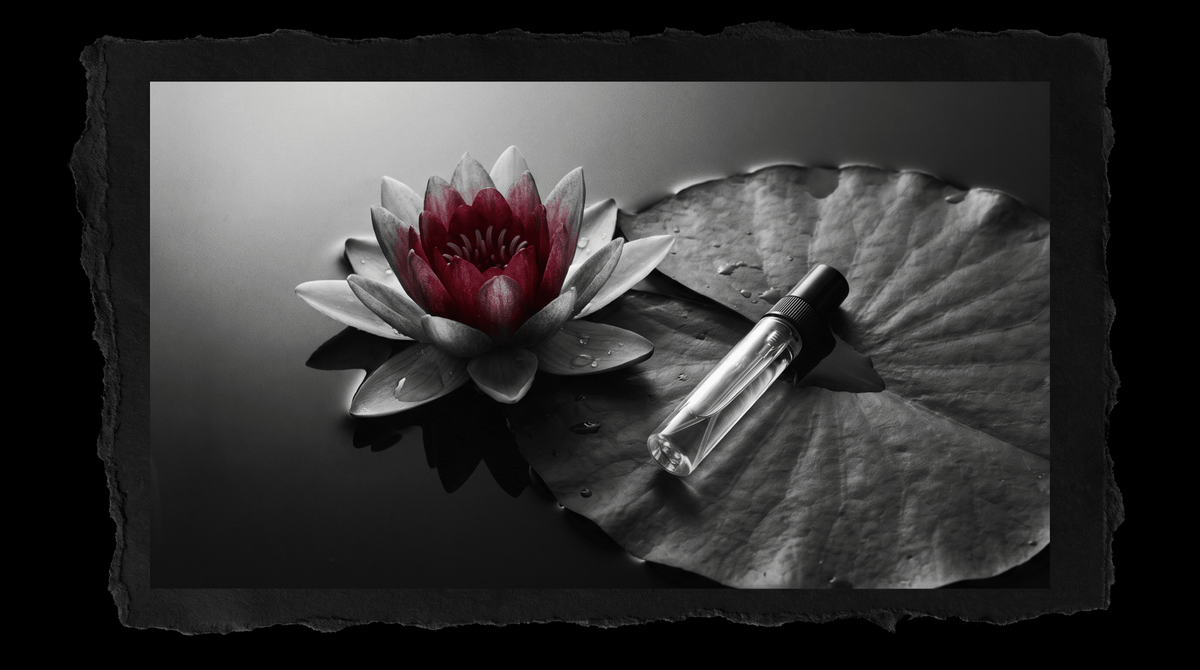
A lotus flower usually smells fresh, watery, soft floral, and slightly sweet, with a green edge rather than the dense richness of jasmine or rose. In perfume language, people most often mean an aquatic-floral impression that feels airy, clean, and calm instead of lush or heady.
You're probably here because you saw “lotus” in a perfume note list and paused. Maybe you pictured something exotic and opulent, only to wonder whether it would smell powdery, sharp, watery, or even like a pond in summer.
That confusion makes sense. Lotus is one of those notes that carries more atmosphere than blunt intensity. It suggests still water, cool petals, soft light, and a kind of quiet space around the scent. But the lotus you smell in nature and the lotus you smell in a bottle aren't always the same thing. That's where many fragrance descriptions get slippery.
A perfumer learns quickly that lotus is less like a trumpet solo and more like a veil. It softens edges. It connects sparkling openings to clean woods and musk. It gives a composition a floating, translucent center. If you know how to listen for it, you can spot it. If you don't, it often slips by as a feeling rather than a clearly named flower.
Table of Contents
- An Introduction to a Mythical Scent
- The Ethereal Scent Profile of Lotus
- The Real Flower Versus The Perfumer's Accord
- Common Fragrance Pairings With Lotus
- How to Detect and Appreciate Lotus in Perfumes
- Begin Your Own Fragrance Journey
An Introduction to a Mythical Scent
At dawn, a lotus pond doesn't announce itself the way a rose garden does. You don't get a thick cloud of perfume rushing toward you. Instead, the air feels cool and faintly floral, touched by moisture, green stems, and the hush of still water. The flower seems to breathe into the morning rather than project across it.
That's part of why lotus feels mythical in fragrance. Its reputation was shaped not only by scent, but by symbolism. In South and East Asian traditions, lotus has long been associated with purity and serenity, and in older Egyptian and Indian imagery it carries an aura of calm, ritual, and transcendence. Those associations matter because they influence how modern perfumery imagines the note.
When people ask what does a lotus flower smell like, they often expect a dramatic answer. They expect something as recognizable as rose, as creamy as tuberose, or as narcotic as jasmine. Lotus rarely behaves that way. It's more elusive.
Lotus is the kind of floral note that many people notice first as a texture. Cool, sheer, and floating.
That's why it appears so often in fragrances meant to feel meditative, airy, modern, or clean-skinned. A perfumer doesn't usually reach for lotus to dominate a formula. They reach for it when they want light passing through the structure.
The result is a note that lives halfway between botanical reality and artistic suggestion. To understand it well, you have to hold both ideas at once. First, the scent itself. Then, the illusion a perfumer creates from it.
The Ethereal Scent Profile of Lotus
Why lotus confuses so many people
Lotus is easy to misunderstand because the words used to describe it can sound abstract. Aquatic, green, soft floral, transparent. Those are real fragrance terms, but they don't help much until you translate them into something your nose can picture.
According to Scento's discussion of perfumes inspired by lotus flower, lotus in perfumery is generally described as fresh, watery, soft floral, and slightly sweet, often with green, herbaceous, or aquatic nuances rather than a heavy or heady floral profile. That's the cleanest starting point.
So what does that mean in plain language?
It means lotus doesn't smell like a bouquet pushed into your face. It smells more like petals cooled by water. Think of the sensation of rinsing a lettuce leaf, slicing cucumber, then placing one pale flower petal nearby. Not edible, not vegetal, not conventionally rosy. Just moist, airy, and delicately alive.

A simple scent map for your nose
If you want to recognize lotus, break it into parts rather than searching for one dramatic note.
Core impression: lotus smells like a clean watery floral with subtle sweetness and a breezy green edge, not a plush floral like rose or a heady white flower like jasmine.
Here's a practical map:
-
Fresh and aquatic
This is the first impression. Not oceanic salt, not melon-heavy “blue water” perfume. More like cool pond air and petals carrying moisture. -
Soft floral
The floral tone is restrained. It sits close to the skin and feels smooth rather than creamy or loud. -
Slight sweetness
Lotus has sweetness, but it's gentle. Think of sweetness dissolved in water, not syrup, candy, or jam. -
Green nuance
Many lotus impressions include something stem-like, dewy, or lightly herbaceous. This keeps the flower from becoming too pretty or cosmetic. -
A bridging effect
Lotus often connects sparkling openings to cleaner woods or musks. If you're curious how a more assertive floral infusion behaves by comparison, this guide to jasmine tea fragrance can sharpen the contrast.
A short comparison makes the profile easier to remember:
| Note | Usual impression |
|---|---|
| Rose | Petal-rich, familiar, often fuller and more obvious |
| Jasmine | Headier, more sensual, often denser |
| Lotus | Airier, wetter, cleaner, more transparent |
Many readers also ask whether lotus smells powdery. Sometimes a perfume may style lotus in a silky or soft-focus way, but the note itself is better understood as watery and translucent than powdery.
That's the important correction. Lotus isn't a big floral statement. It's the shimmer around one.
The Real Flower Versus The Perfumer's Accord
Two flowers, two moods
“Lotus” is one of those fragrance words that sounds precise but often isn't. Different plants are discussed under the same umbrella, and the scent profile shifts with them.
As described in Teachers Academy's overview of lotus traditions and scent profiles, there are two commonly referenced botanical scent profiles in lotus discussions. Pink lotus (Nelumbo nucifera) is described as mildly sweet, fresh, and floral. Blue lotus (Nymphaea caerulea) is described as more musky-sweet, rich, and slightly narcotic.
That distinction clears up a lot of confusion. If one person describes lotus as barely there and watery while another calls it deep and meditative, they may not be imagining the same thing at all.
You can think of them as two moods:
- Pink lotus leans toward brightness, delicacy, and a fresh bloom floating on water.
- Blue lotus leans toward duskier sweetness, a softer haze, and a more inward, almost ritual feeling.
What perfumers build when they say lotus
Now for the part most articles skip. The lotus note in perfume is often an accord, not a direct one-to-one portrait of the living flower.
A living bloom is fleeting, variable, and shaped by air, water, heat, and time of day. A perfumer, by contrast, needs something stable, legible, and useful inside a composition. So “lotus” in a bottle often means a carefully composed illusion built to highlight certain facets and suppress others.

Premiere Peau notes in its lotus glossary entry that lotus in perfumery is typically evaluated as an aquatic-floral note that smells “watery, soft, ethereally transparent,” with a cool pond-like effect. The same source adds that when a natural pink lotus absolute is used, the profile becomes richer: honeyed, earthy-creamy floral, with a green top note, ripe-fruit facets, and coumarin-like undertones.
That contrast matters. It tells you that “lotus” can refer to at least two different artistic directions.
| Version | What you're likely to smell |
|---|---|
| Transparent lotus accord | Watery, airy, cool, clean, modern |
| Natural pink lotus absolute | Honeyed, earthy-creamy, greener, more textured |
A perfumer rarely asks, “How do I copy the flower exactly?” The better question is, “Which part of the flower's character do I want the wearer to feel?”
That's why some lotus perfumes read almost like chilled water over pale petals, while others feel warmer, more nectar-like, and softly earthbound. Neither is wrong. They're different translations.
For an apprentice nose, this is the breakthrough. Stop looking for one fixed lotus smell. Start asking which lotus has been imagined: the dew-bright bloom, the musky blue reverie, or the richer natural absolute with honey and green shadows.
Common Fragrance Pairings With Lotus
Lotus becomes easier to understand once you see what it does next to other notes. Alone, it can seem faint. In company, its function becomes obvious. It lifts, cools, softens, and links one part of a fragrance to another.

Lotus with bright notes
The fresher idea of lotus works beautifully with crisp materials. The reason is simple. Lotus has a watery, green, lightly sweet profile, so it can carry brightness without turning sour or shrill.
Common pairings often include:
- Fig leaf for a milky green softness that feels modern and airy
- White pepper for a dry sparkle that keeps the floral heart sheer
- Cardamom when a perfumer wants cool spice rather than kitchen warmth
- Citrus peel to create a dewy opening with more poise than a straightforward cologne effect
Pink lotus is especially useful here because it's commonly described as mildly sweet and fresh. It supports a bright, clean effect without feeling soapy.
Lotus with woods, musk, and spice
Lotus also has a gift for making base notes feel cleaner and more breathable. That's why it often appears beside vetiver, soft musk, and smooth woods. Instead of dropping from a sparkling top into a dry base too abruptly, the fragrance glides.
Blue lotus-inspired pairings take a different route. Because blue lotus is often described as more musky-sweet and rich, perfumers can steer it toward a more meditative, narcotic atmosphere. In those compositions, spice and resinous warmth feel natural.
A useful way to think about the pairings:
- Lotus and vetiver feel like wet green stems over cool earth.
- Lotus and musk create the clean-skin effect many wearers love in warm weather.
- Lotus and cardamom produce a chilled, elegant contrast.
- Lotus and white pepper add lift and quiet tension.
- Lotus and richer floral or balsamic notes can tilt toward a duskier, more introspective mood when the perfumer is drawing from the blue lotus idea.
If a perfume feels serene, watery, and softly structured rather than loudly floral, lotus may be doing more of the work than the note list suggests.
The note displays remarkable skill. Lotus doesn't only smell beautiful. It organizes space inside a fragrance.
How to Detect and Appreciate Lotus in Perfumes
Train your nose in layers
Lotus won't always jump off a blotter and introduce itself. You have to learn how to listen for it. Start by looking for the signs of its presence rather than waiting for a literal flower smell.

Use this method:
-
Read the note list carefully
Look for “lotus,” but also watch for related watery floral language. Some brands use adjacent terms that point toward a similar effect. -
Smell on paper first
On a blotter, notice whether the fragrance opens with a cool, dewy, transparent floral layer rather than a juicy or sugary one. -
Then test on skin
Lotus often becomes clearer when the sharpest top notes settle. On skin, ask whether the perfume feels humid, clean, green, and softly luminous. -
Track the transition
Because lotus often acts as a bridge, pay attention to the passage from opening to heart to drydown. If a fragrance moves gracefully from sparkle to musk or wood, lotus may be part of the stitching. -
Compare multiple scents side by side
This is the fastest way to train your nose. One perfume may present lotus as sheer and aquatic. Another may render it honeyed or creamy.
A deeper testing routine helps. This guide on how to properly test a perfume step by step is useful if you want a more disciplined way to compare notes on skin and paper.
Here's a visual walkthrough to reinforce what to notice while smelling:
What to compare when sampling
The best way to understand lotus is through contrast. Don't smell one “lotus perfume” and assume you've solved the note.
Try comparing perfumes that differ in style:
- One clean aquatic floral to study transparency
- One green-musky scent to learn how lotus behaves as a connector
- One richer floral composition to see how a more textured lotus idea can feel warmer
On a practical level, decants make this easier because you can wear several interpretations over time instead of relying on one fast counter test. Decant Sample offers authentic fragrance decants in small formats, which suits this kind of note-by-note comparison.
Smelling rule: if you can't name lotus directly, ask whether the perfume feels like cool water passing through petals on its way to musk or wood.
That question often reveals the note faster than chasing a textbook definition.
Begin Your Own Fragrance Journey
By now, the answer to what does a lotus flower smell like should feel less mysterious, but more interesting. It isn't one blunt aroma. It's a family of impressions. Watery, soft floral, lightly sweet, green around the edges, sometimes airy and translucent, sometimes richer and more honeyed depending on the material and the perfumer's hand.
That's why lotus rewards patience. It asks you to smell for texture, movement, and atmosphere. It also teaches a useful lesson about fragrance language. A note name on a bottle is often an interpretation, not a botanical promise.
If you enjoy mapping fragrance families around a note, tools that let you search perfume by notes can make exploration much easier. And if you want a broader style reference for floral taste, this roundup of best fragrances for women from Cedar & Lily Clothier offers a helpful look at how different floral personalities are framed for everyday wear.
The pleasure of lotus is that it doesn't shout. It invites. One perfume may give you dawn on still water. Another may suggest silk, skin, and pale light. A third may lean into ritual, shadow, and gentle sweetness. All of them can teach you something.
The more you compare, the more your nose stops asking, “Do I smell a flower?” and starts asking, “What feeling is this note creating?”
If you want to explore lotus in real perfumes without committing to a full bottle, Decant Sample lets you try discovery sizes from a wide range of authentic fragrances so you can compare different interpretations on your own skin.


