

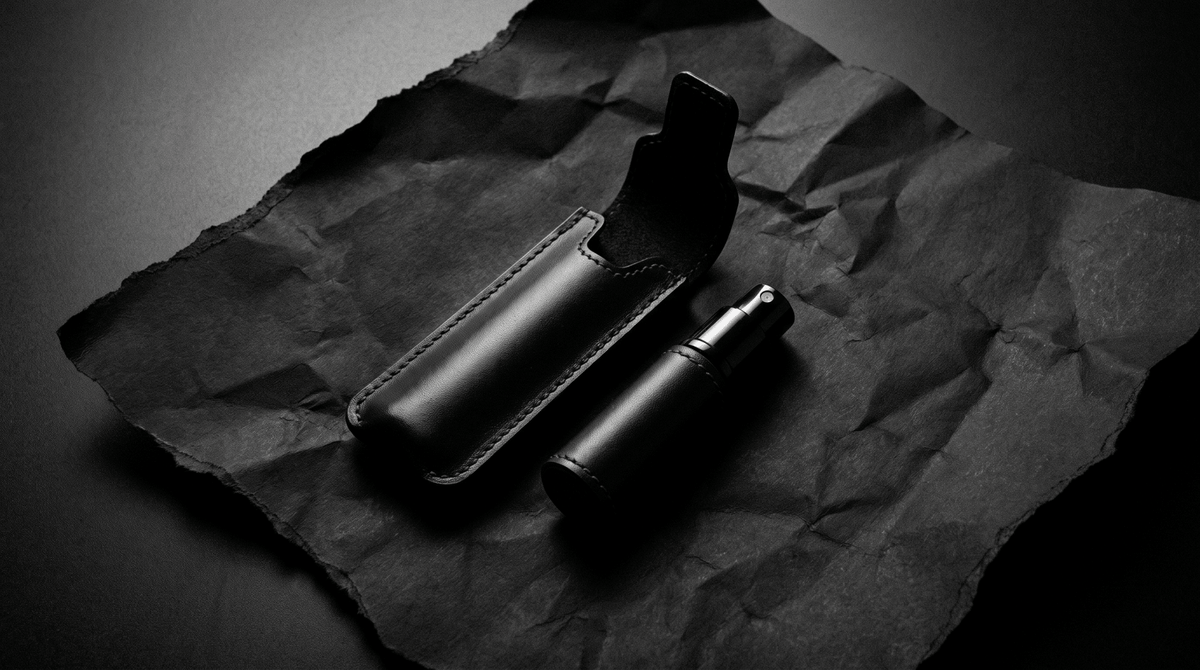
A fragrance lover knows the feeling. You're packing for a weekend away, your full bottle is sitting on the dresser, and suddenly that beautiful flacon looks less like a luxury object and more like a liability. Heavy glass, a cap that could loosen in transit, and juice you'd hate to waste if the bottle leaks into a leather wash bag.
That tension gets sharper when the scent isn't replaceable. A niche extrait, a city exclusive, a discontinued release, or a particular fragrance you wear because nothing else does the same thing. These aren't bottles you toss into luggage and forget. They need a better system.
A good travel size perfume holder solves the obvious problem of portability, but convenience is only the beginning. For serious fragrance users, the real question is preservation. Will the holder protect the formula from evaporation, contamination, and rough handling? Will it keep the spray behavior elegant? Will it respect the character of the perfume, or reduce it to a crude transfer from one bottle to another?

That's why this category keeps growing. The global travel perfume market was valued at $1.5 billion in 2023 and is projected to reach $2.3 billion by 2031, implying a 6.1% CAGR from 2024 to 2031, according to travel fragrance sales figures compiled here. People want smaller fragrance formats, but they also want smarter ones.
The same instinct shows up elsewhere in beauty. Anyone who invests in refined formulas, whether fragrance or luxury Japanese skincare brands, usually learns the same lesson quickly. Packaging matters because preservation matters.
Table of Contents
- Introduction Why Your Luxury Scent Deserves a Better Travel Companion
- Comparing the Main Types of Perfume Holders
- How to Choose the Right Holder for Your Fragrance
- Navigating Airline Rules with Your Perfume
- Best Practices for Filling and Caring for Your Holder
- Troubleshooting Common Perfume Holder Problems
Introduction Why Your Luxury Scent Deserves a Better Travel Companion
A proper travel size perfume holder is a small vessel designed to make fragrance portable without turning it into an afterthought. The common working size is 5 ml to 15 ml, while many sellers use 5 ml to 30 ml as the broader travel-size range. For air travel, the usual carry-on liquid limit is 100 ml (3.4 oz) or less in a quart-sized bag, which is why compact fragrance containers became so useful for frequent flyers, as outlined in this guide to travel perfume sizing.
For perfume, that size range matters for another reason. It encourages restraint. Instead of hauling a full presentation bottle, you carry only what you'll wear. That reduces breakage risk and limits how much juice is exposed every time you handle your travel kit.
Why these holders exist
A travel holder does three jobs at once:
- Portability: It shrinks a fragile ritual into something pocketable.
- Protection: It creates a barrier between your fragrance and the abuse of transit.
- Usability: It lets you reapply without taking out a large bottle in public.
Those sound simple, but they affect the wearing experience more than most buyers expect. A poor holder dribbles, floods, or changes the application pattern. A good one behaves like a miniature instrument.
Practical rule: Don't think of a travel holder as just a smaller bottle. Think of it as a delivery system for a formula you care about.
Decants and holders are related, but not identical
Collectors often use the terms loosely, though they serve different purposes. A decant is the transferred fragrance itself, usually drawn from an original bottle into a smaller format. A holder is the container or case that makes that smaller format usable on the move. If you want a clearer primer on how decants work, this beginner's guide to perfume decants is a useful reference.
That distinction matters because some luxury scents travel better in a dedicated decant bottle than in a refillable shell with more moving parts. The right answer depends on the fragrance, the trip, and your tolerance for transfer risk.
Comparing the Main Types of Perfume Holders
Some formats suit fresh daily wear. Others are better for dense oils, formal travel, or preserving the identity of a precious scent. The mistake is assuming they're interchangeable.

What each holder actually does
| Holder Type | Best For | Application | Pros | Cons |
|---|---|---|---|---|
| Refillable atomizer | Most spray perfumes | Fine mist spray | Familiar application, compact, easy to refresh discreetly | More parts can mean more failure points |
| Refillable roll-on | Oils or targeted wear | Direct roll to skin | Quiet, precise, simple to carry | Can change how a spray perfume develops on skin |
| Solid perfume compact | Balm or wax-based scent | Finger or direct dab | Very travel-friendly, tidy, no misting | Not suitable for most liquid luxury perfumes |
| Protective case for minis or decants | Official travel sprays, branded minis, glass decants | Depends on bottle inside | Preserves original vessel identity, adds impact protection | Bulkier than a bare atomizer |
A spray perfume usually feels most natural in an atomizer because it preserves the cloud and distribution the perfumer intended. That broad mist matters with compositions built around lift, texture, and diffusion. Citrus, aldehydes, neroli, bright musks, and many transparent florals lose some of their elegance when applied as a streak or dab.
Roll-ons work well with perfume oils and with users who prefer a low-profile application to pulse points. They're less ideal for many alcohol-based fine fragrances because they concentrate placement and can make a scent feel flatter or denser than intended.
Where quality shows up
With atomizers, the hidden engineering matters more than the finish. High-quality travel perfume holders are commonly built around aluminum or thick-glass mini bottles, and one marketed no-leak atomizer gives a useful benchmark of about 50 sprays from a 5 ml reservoir. That's from this technical overview of travel atomizers and bottle limits.
That benchmark isn't important because every atomizer will perform identically. It's useful because it tells you what to examine. The holder has to meter sprays consistently, seal tightly, and avoid wasting fragrance through seepage or premature evaporation.
Look closely at these points before you trust any refillable atomizer:
- Pump integrity: A weak pump head often sputters or floods.
- Fill interface: If the transfer point feels loose, leakage often starts there.
- Inner material: The reservoir should feel sturdy, not flimsy or reactive.
- Cap security: A stylish cap that lifts too easily isn't protecting much.
- Body construction: Aluminum protects from knocks. Thick glass gives a cleaner, more inert feel.
A luxury fragrance doesn't forgive sloppy hardware. You'll smell the difference in the air, and sometimes in the bottle.
Protective cases deserve more attention than they get. If you already own an official travel spray, branded mini, or well-made decant bottle, a fitted case can be the best holder because it adds shock protection without requiring another transfer. That's often the most conservative choice for collectors.
If you're comparing options in detail, this roundup on perfume atomisers helps frame what separates a useful atomizer from one that only looks polished online.
How to Choose the Right Holder for Your Fragrance
The right holder starts with the perfume itself, not the accessory. Some scents are forgiving. Others punish every careless transfer, every loose seal, and every cheap component.
Match the holder to the perfume
Bright, volatile structures need clean spraying. Think citrus colognes, sheer florals, incense mists, soft woods, and fragrances built around radiance rather than density. Those usually benefit from an atomizer that delivers a proper mist. A dab or roll-on can make them feel compressed.
Heavier compositions tolerate direct placement better. Dense amber, oud, leather, resinous orientals, and many extrait styles often still smell beautiful when applied more narrowly. But tolerance isn't the same as preference. If a scent was composed to bloom from a spray arc, that remains the ideal experience.
Material choice matters here too. Thick glass feels safest for scent purity. Aluminum adds welcome protection in a bag, especially if the inner container is well made. The key is avoiding flimsy, vaguely finished holders that smell of manufacturing residue or feel loose around the valve.
Match the holder to the trip
A short city break is one kind of problem. A long itinerary with layovers, climate shifts, and repeated repacking is another.
For a brief trip, a compact spray holder is usually enough if the mechanism is dependable. For longer travel, durability starts to matter more than elegance. You want a holder that can survive being packed, unpacked, and carried daily without turning into a mystery leak.
Some buyers also care about how the object feels in use. That's reasonable. Luxury is tactile. If the cap rattles, the spray head catches, or the refill system feels clumsy, you'll stop using it and go back to risky habits with full bottles.
When not to use a generic holder
This is the part generic travel advice usually ignores. A refillable holder is not always the right format for a luxury fragrance user.
A key consideration is that official branded minis or direct-from-bottle decants can be better for preserving scent integrity and bottle identity, a trade-off often overlooked when convenience becomes the only criterion, as noted in this market view of travel perfume holder preferences.
That matters most in a few situations:
- Rare or discontinued scents: Every transfer introduces handling risk.
- Giftable travel fragrance: Branding and presentation are part of the pleasure.
- Sentimental bottles: You may want continuity with the original house design.
- Strict authenticity concerns: A clearly sourced decant can feel more trustworthy than an anonymous refillable shell.
If your priority is preserving the exact character of a fragrance from the original bottle, a direct-from-bottle decant may be the cleaner answer. One option in that category is Decant Sample, which offers authentic fragrance decants in small travel-oriented formats rather than asking you to refill a generic holder yourself.
Navigating Airline Rules with Your Perfume
Air travel is where a travel size perfume holder proves its value. Not because perfume is hard to carry, but because airport rules punish vague packing.

What the liquid rule means in practice
For fragrance, the practical takeaway is simple. Keep each perfume container at or below the standard carry-on limit and place it with your other liquids in a clear quart-sized bag. A travel holder fits this system far better than a large decorative bottle.
That's one reason small perfume formats became normal among frequent travelers. They're easier to inspect, easier to pack, and far less awkward when security asks you to separate liquids.
If you want a quick reference for how fragrance formats compare across sizes, this guide to cologne bottle sizes helps put travel formats into context.
Packing habits that reduce risk
Even compliant perfume can fail in transit if it's packed carelessly.
- Tighten before packing: Check cap, spray head, and any refill collar before the holder goes into your liquids bag.
- Keep it upright when possible: It won't always stay that way, but starting from a stable position helps.
- Use a soft sleeve if the holder is glass: Friction and impact are different problems. Cushioning helps with both.
- Avoid overpacking the liquids bag: Pressure from other containers can trigger accidental spraying or loosen caps.
- Choose carry-on over checked luggage: Your fragrance stays with you, and you can inspect it if something feels off.
Cabin travel is demanding enough. Don't add a vulnerable full-size bottle unless you have no alternative.
I also prefer not to fill a travel holder to its absolute limit before flying. A little room inside the container can make the holder feel less stressed during movement and handling. It's a small habit, but it reduces mess.
Best Practices for Filling and Caring for Your Holder
Most problems blamed on the holder originate during the refill. Spills, cross-contamination, and poor sealing usually come from impatience.

How to fill without wasting perfume
Set up on a stable surface with good light. Keep the original bottle, the empty holder, and any funnel or transfer tool clean and dry before you begin. If the holder uses a bottom-fill system, check that the valve sits flush and doesn't wobble.
For most liquid fragrances, a careful transfer works best when you slow down:
- Prepare the bottle and holder: Remove caps fully and inspect the spray stem or opening.
- Work in small increments: Don't rush to fill it all at once.
- Pause before sealing: Let any droplets settle around the neck so you can see whether liquid is pooling where it shouldn't.
- Wipe the exterior: Residue on the outside gets mistaken for leaks later.
- Test one spray away from fabric: You're checking mist quality and seal integrity, not admiring the scent.
A clean first spray tells you a lot. If the atomizer coughs, spits, or dribbles, fix the issue before travel. Don't assume it will improve in your bag.
Residue around the neck is the beginning of most “mystery leaks.” Clean it before you judge the holder.
A visual walkthrough can help if you're using this type of format for the first time:
How to clean between scents
Never move a new fragrance into a holder that still carries the ghost of the last one. That's how a transparent iris ends up with traces of oud, vanilla, or amberwood where it doesn't belong.
A simple care routine is enough:
- Empty the holder fully: Don't layer a new scent over leftovers.
- Disassemble what you safely can: Only if the design allows it without damage.
- Rinse appropriately for the holder type: Follow the maker's care guidance and allow all parts to dry completely.
- Store uncapped until dry: Moisture trapped inside is worse than a brief wait.
- Label your holders: Especially if you rotate several scents during one season.
If you collect multiple perfumes, dedicate certain holders to fragrance families. One for fresh citrus and neroli, another for woods, another for richer evening scents. That habit reduces cleaning and keeps profiles cleaner over time.
Troubleshooting Common Perfume Holder Problems
Even well-chosen holders can misbehave. The usual issues are leaks, clogs, and gradual loss of scent from poor storage.
Leaks
A leak often starts at the cap, valve, or refill point rather than through the body itself. Check for perfume residue around seams. If you see shine or smell concentrated fragrance on the outside, clean everything, reseat the parts, and test the holder upright before packing it again.
Don't fill the reservoir to the very top. Leaving a little space makes the holder easier to seal cleanly and often reduces stress around the closure.
Clogs
A clog usually shows up as a weak spray, sputtering, or a stream instead of a mist. Dried residue around the nozzle is a common culprit. Clean the spray area gently and test again before deciding the atomizer has failed.
Some fragrances are less forgiving in small mechanisms, especially if the holder has sat unused for a while. Regular use and proper cleaning help.
Evaporation
If the fragrance seems to disappear faster than expected, suspect the seal first. A holder can look closed and still allow slow loss. That's why solid construction matters more than decorative finish.
Store the holder away from heat and direct light, and don't leave transferred perfume sitting indefinitely if it's a scent you highly value. Travel formats are for active use, not casual long-term storage.
If you'd rather avoid the uncertainty of refilling generic holders, Decant Sample offers authentic perfume decants in compact formats that suit testing, travel, and carrying luxury scents with less handling. For collectors and frequent flyers, that can be a simpler way to keep precious fragrances portable without bringing the full bottle.


